In class the other day, we had a discussion over whether Paul D was the past or the future. We seemed to conclude that Beloved represented the future and Paul D the past, but after some more reading, I have to disagree with this idea.
First of all, a ghost itself goes against the idea of the future. In my opinion, Beloved is merely a remnant of the past, something that could have been had Sethe not killed her. After Sethe (finally) realizes that Beloved is her daughter, it looks like she gives up on her life. She doesn't seem to care about her work anymore and believes that "there is no world outside her door." She then "locks the door tight behind her" and wallows in her past with her children. I'm reminded of the last few lines of Their Eyes Were Watching God when Janie "pulled in her horizon like a great fish-net. Pulled it from around the waist of the world and draped it over her shoulder. So much of life in its meshes!" Janie and Sethe both withdraw to their pasts and it doesn't seem like they will comeback to the present.
But where does Paul D stand in all of this? His motives and intentions are pretty unclear. At first, it seems like staying at 124 is something he really wants. He wants to "make a life" with Sethe, settle down, and become a more family man. This seems like a possible future and positive direction for the family. And yet, after a period of time, Paul D begins having 'house-fits,' where he moves from room to room, farther and farther away from the house. He eventually ends up in the cold house, sleeping with only newspapers to shield him from the cold of winter. He does this to get away from a woman's house which he believes to be 'binding' him. Paul D believes he is "moving out of 124" Bluestone.
Yet this statement seems contradictory to what Paul D actually says. He explains that while he can't remain in the house, he also doesn't want to be anywhere else. Instead of telling Sethe that he is having trouble living in her house, he proposes the idea of having a kid, which would forever tie him down to Sethe, her family, and her house. Perhaps Paul D's itch to leave the house has more to do with Beloved and Denver. Paul D believes that his desire to leave the house has nothing to do with Sethe, who he claims to love. But this argument, too, has flaws. At times, Paul D acts as though Sethe is just a plaything. True, there are the occasional appreciations of her character and personality but it seems like, above all, Paul D just likes sleeping with her (and this too is questionable since he sexually engages with Beloved...).
But despite his flaws, I feel like Paul D would be a much better influence on Sethe's life than Beloved. True, Paul D brings past memories of Sweet Home, but as the carnival suggests, he can create new memories and experiences with Sethe and reintroduce her to the town (town life being something Sethe describes as "28 days of freedom"). I don't see Beloved as a healthy future, so I hope Sethe chooses the man over the ghost.
Sunday, December 14, 2014

Sunday, December 7, 2014
Graffiti
After the discussion of Style Wars on Thursday night, I was again getting a ride home from Natalie Hummel. One of the things we had talked about after the documentary was the graffiti between the Courier Café and Pizza M's in downtown Urbana. Curious, Natalie and I took a field trip to see the artwork mentioned during the class discussion. Here's what we saw:

But then I realized that the graffiti in Urbana isn't incredibly large compared to the sizes of pieces in other cities or other countries...


(not really graffiti since it only exists in digital form, but close enough)
Orange Scraps and Carmine Velvet
I'm not sure if I'm the only one who has noticed this, but there has been a surprising lack of color in the book Beloved, by Toni Morrison. While Invisible Man was loaded with references to black and white, Morrison's novel is more subtle as to when it mentions color. This leads me to believe that when Morrison uses color, she does so very deliberately.
Perhaps the most described color in Beloved is the color red. One of the first descriptions we get of 124 Bluestone is the "red and undulating light" that Paul D finds when he steps into the house. The red light here seems to represent the spirit of the dead baby which isn't evil, but 'sad,' according to Sethe (although the emotions of the baby can be disputed). "Red baby blood," the dying roses at the carnival, and Sixo's fiery red tongue are other examples of color imagery that, like the spirit of the dead baby, evokes images of the past, death, and of things lost. Red is also used to describe Amy Denver's velvet. The carmine velvet sounds rich and luxuriant but I can't help but wonder if this vision of velvet is only a dream that Amy will never realize. Morrison also uses red to symbolize white supremacy and brutality, by using it to talk about Mister's red comb and Sethe's red chokecherry tree. Overall, the color red that Morrison uses seems to symbolize death and suffering, or longing and the past
There are a few other colors that seem to hold some significance in the novel. Orange, for example, is noted as being "wild." The quilt with the orange patches gives life to Beloved when she's sick and gives comfort to Baby Suggs before she dies. However, I think that orange too is tied to the suffering in the house because the blanket is for the bodies of the sick and dying. Pink is also an important color because it is described as being "the last color Sethe remembered." This is because pink is the color of Beloved's headstone, and thus the color becomes yet another to be associated with death. Orange and pink are quite similar in shade to red, and so maybe that's why Morrison uses them all in a morbid way.
I think it is interesting that white and black are not more commonly used in the novel. It's clear that Baby Suggs, at least, hates whites but there are no sections of Beloved that are like the paint factory scene in Invisible Man. Rather Morrison depicts black and white as "absences" of color and instead tries to point out the importance of other colors that aren't so closely linked to slavery.
Perhaps the most described color in Beloved is the color red. One of the first descriptions we get of 124 Bluestone is the "red and undulating light" that Paul D finds when he steps into the house. The red light here seems to represent the spirit of the dead baby which isn't evil, but 'sad,' according to Sethe (although the emotions of the baby can be disputed). "Red baby blood," the dying roses at the carnival, and Sixo's fiery red tongue are other examples of color imagery that, like the spirit of the dead baby, evokes images of the past, death, and of things lost. Red is also used to describe Amy Denver's velvet. The carmine velvet sounds rich and luxuriant but I can't help but wonder if this vision of velvet is only a dream that Amy will never realize. Morrison also uses red to symbolize white supremacy and brutality, by using it to talk about Mister's red comb and Sethe's red chokecherry tree. Overall, the color red that Morrison uses seems to symbolize death and suffering, or longing and the past
There are a few other colors that seem to hold some significance in the novel. Orange, for example, is noted as being "wild." The quilt with the orange patches gives life to Beloved when she's sick and gives comfort to Baby Suggs before she dies. However, I think that orange too is tied to the suffering in the house because the blanket is for the bodies of the sick and dying. Pink is also an important color because it is described as being "the last color Sethe remembered." This is because pink is the color of Beloved's headstone, and thus the color becomes yet another to be associated with death. Orange and pink are quite similar in shade to red, and so maybe that's why Morrison uses them all in a morbid way.
I think it is interesting that white and black are not more commonly used in the novel. It's clear that Baby Suggs, at least, hates whites but there are no sections of Beloved that are like the paint factory scene in Invisible Man. Rather Morrison depicts black and white as "absences" of color and instead tries to point out the importance of other colors that aren't so closely linked to slavery.
Monday, November 10, 2014
Caucasian
Since our discussion of white culture a few days ago, I've been thinking a lot about what "white culture" means. I attempted to put my thoughts to the page several times, all very unsuccessfully. So, in the spirit of The White Boy Shuffle, I decided to write a poem reflecting some of my thoughts on what it means to have a white culture (specifically in Urbana).
in our booster seats
as mom drives us to the bookstore.
we sit in the kids section
flipping through roald dahl.
dr suess.
strawberry field's and co-op(-eration),
we play operation when
dad goes to work.
he returns for dinner
at 6:30, sharp.
stand still
and let mom dress us up
hannah anderson, ralph lauren, merrell
names said as she brushes
our thin brown hair
petit racquets,
ones we grip for forehand volleys
every tuesday and thursday
while we produce pristine beads of sweat
and drink cool bottled water.
back at school, we study colors,
cultures teachers say are easier than the
alphabet.
but i don't know.
if white has no color but absorbs them all too,
what am i?
beige i guess.
---
the cadillac bumps us up and downin our booster seats
as mom drives us to the bookstore.
we sit in the kids section
flipping through roald dahl.
dr suess.
strawberry field's and co-op(-eration),
we play operation when
dad goes to work.
he returns for dinner
at 6:30, sharp.
stand still
and let mom dress us up
hannah anderson, ralph lauren, merrell
names said as she brushes
our thin brown hair
petit racquets,
ones we grip for forehand volleys
every tuesday and thursday
while we produce pristine beads of sweat
and drink cool bottled water.
back at school, we study colors,
cultures teachers say are easier than the
alphabet.
but i don't know.
if white has no color but absorbs them all too,
what am i?
beige i guess.
Sunday, November 9, 2014
Jar Jar Binks: A Racist?
In last week's showing of Ethnic Notions, we were shown crude cartoons of happy-go-lucky mammies, uncles, Sambos. All were portrayed as stupid, and the faces were unforgivably exaggerated. Racism in the first half of the 1900's (and earlier) was clear-cut and obvious. But in present-day America, the line between socially acceptable and inadmissible is very blurred.
In the class discussion following the documentary, we were all amazed at how many racist characters we were able to name from today's popular culture, all of whom we had never realized fit into racial stereotypes. The Suite Life's Mr. Moseby was one that we talked about in class for being a mammy-like figure in that he took care of Zack and Cody. Adding to this list of mammy characters, we could say that Eddie Murphy's character in movies such as Daddy Cay Care or Imagine That or Dwayne "The Rock" Johnson's role in The Game Plan, could also be considered mammy roles.


Also fitting into roles defined by Ethnic Notions to be racist are the "Black Rambos" (I think that's what the film called them) which are the African American sidekicks, normally cops, who crack jokes and like violence. Again, a whole list of characters come to mind: Chris Tucker in Rush Hour, Eddie Murphy (again) in Tower Heist, etc. I'm sure you can come up with many more, especially if you generalize and count black sidekicks (there seems to be one in every show/movie)
My first reaction was one of horror, I've been consuming all of these stereotypes, not realizing any of it? As evidenced, there are so many examples of African American characters who fit into certain racist categories. Even our favorite character Jar Jar Binks, from the first Star Wars movie, is suggested to be racist because of his Caribbean accent, dim-witted character, bell bottoms and vest, and ears that are suggested to look like dreadlocks.

In the class discussion following the documentary, we were all amazed at how many racist characters we were able to name from today's popular culture, all of whom we had never realized fit into racial stereotypes. The Suite Life's Mr. Moseby was one that we talked about in class for being a mammy-like figure in that he took care of Zack and Cody. Adding to this list of mammy characters, we could say that Eddie Murphy's character in movies such as Daddy Cay Care or Imagine That or Dwayne "The Rock" Johnson's role in The Game Plan, could also be considered mammy roles.


Also fitting into roles defined by Ethnic Notions to be racist are the "Black Rambos" (I think that's what the film called them) which are the African American sidekicks, normally cops, who crack jokes and like violence. Again, a whole list of characters come to mind: Chris Tucker in Rush Hour, Eddie Murphy (again) in Tower Heist, etc. I'm sure you can come up with many more, especially if you generalize and count black sidekicks (there seems to be one in every show/movie)
My first reaction was one of horror, I've been consuming all of these stereotypes, not realizing any of it? As evidenced, there are so many examples of African American characters who fit into certain racist categories. Even our favorite character Jar Jar Binks, from the first Star Wars movie, is suggested to be racist because of his Caribbean accent, dim-witted character, bell bottoms and vest, and ears that are suggested to look like dreadlocks.

At some point, it seems like we've gone too far. Are we just looking for racism? What's wrong with having a funny alien with long ears? And as for the African American sidekicks and babysitters/single fathers, aren't there hundreds of white characters who play the exact same roles?
I think that the problem with our depictions of African Americans is not that there are too many funny sidekicks, it's the lack of serious black characters.
On the drive home from the Ethnic Notions movie night, Natalie Hummel and I tried to see if we could think of a single thoughtful African American protagonist in recent films/TV shows. We could barely come up with five. That is, in my opinion, scarier than the long list of comedic relief characters.
Monday, November 3, 2014
Gunnar and the Gun Totin' Hooligans
As we begin to delve into The White Boy Shuffle (I know, a new book already!) I think Gunnar's move to the hood is very interesting. At first, it seems as though he hates this neighborhood of hypodermic needle-littered parks and racist police officers. The 'hood' is very different from the environment he lived in in Santa Monica. There he had many friends, though he did feel a bit different from his predominantly white classmates, but in the hood Gunnar and his sisters are very much the outcasts. They are mercilessly beaten and insulted daily for being "white Negroes." And yet, Gunnar very much wants to become affiliated with a gang, which he describes as becoming a "soul brother".
At first I was very confused. Why would Gunnar want to forge a relationship with a group like the "Gun Totin' Hooligans" after he's abused time and time again by these gangs? But after our recent class discussions, it seems like his family legacy may have something to do with it. The Kaufmans have a history of being Uncle Tom's and bending down to racism (ex. Swen Kaufman running into slavery, Franz von being a 'seeing eye dog' for his master, and even his father being a sketch artist for the LAPD). But Gunnar tells the reader that while most fruit don't fall far from the tree, he's "tried to roll down the hill at least a little bit." By that, he means he wants to get away from his family's willing submissiveness to whites. So when Gunnar moves out of Santa Monica and into a neighborhood where he's surrounded by people of his own race, I think he feels it's an opportunity to break away from the Kaufman line (a gang member is definitely different than an Uncle Tom).
Of course, tied into this are wishes to fit in to a new environment and find some sort of identity, but I think that differentiating himself from his shameful lineage is the main reason for Gunnar's determinedness to join a gang, even if it means getting beat up and humiliated.
At first I was very confused. Why would Gunnar want to forge a relationship with a group like the "Gun Totin' Hooligans" after he's abused time and time again by these gangs? But after our recent class discussions, it seems like his family legacy may have something to do with it. The Kaufmans have a history of being Uncle Tom's and bending down to racism (ex. Swen Kaufman running into slavery, Franz von being a 'seeing eye dog' for his master, and even his father being a sketch artist for the LAPD). But Gunnar tells the reader that while most fruit don't fall far from the tree, he's "tried to roll down the hill at least a little bit." By that, he means he wants to get away from his family's willing submissiveness to whites. So when Gunnar moves out of Santa Monica and into a neighborhood where he's surrounded by people of his own race, I think he feels it's an opportunity to break away from the Kaufman line (a gang member is definitely different than an Uncle Tom).
Of course, tied into this are wishes to fit in to a new environment and find some sort of identity, but I think that differentiating himself from his shameful lineage is the main reason for Gunnar's determinedness to join a gang, even if it means getting beat up and humiliated.
Wednesday, October 15, 2014
Mist' Starks
The cast of Their Eyes Were Watching God has been steadily growing as we get deeper into the book. One character in particular has me feeling conflicted: Joe Starks.
When we first see Joe he's a "cityfied, stylish dressed man" with three hundred dollars in his pocket and big dreams. He promises to treat Janie like a lady, and when she throws off her apron to run away and marry him, I was cheering for her (at the very least, Joe seems like a big step up from Logan Killicks).
But soon it becomes clear that Joe is extremely patronizing/sexist. According to him, "a woman's place is in de home," when a woman speaks they are getting "too moufy," and even a game like checkers is "too heavy fuh de brains" of a female. It seems as though his vision of a woman is one who remains silent and sits pretty for the men to stare at ("she was there in the store for him to look at"). To make it worse, he hits Janie when she insults his pride, or when she cooks a dinner he doesn't like.
Yet when we get a little bit of insight into Joe's own thoughts, we can see that he acts the way he does for good reasons. He wants to "make a big woman outa" Janie. He believes that by making "a pretty doll-baby like Janie sit on de front porch and eat p'taters dat other folks plant just special for her," he will make her happy. In his eyes Janie is above the "gum-grease" of society and he does his best to keep her out of unfavorable social events.
I think it's important to note that he also performs a lot of good deeds for the town: saving a mule from its misery, giving free food to the poorer people of the town, etc. Here Joe's actions are generous but it's possible that the motivation behind them was just to gain more status in society. In fact, Joe could be trying to put Janie on a pedestal just to make himself look better.
Good guy, bad guy, it's kind of hard to tell, but maybe the switch from Logan to Joe wasn't so glorious after all.
When we first see Joe he's a "cityfied, stylish dressed man" with three hundred dollars in his pocket and big dreams. He promises to treat Janie like a lady, and when she throws off her apron to run away and marry him, I was cheering for her (at the very least, Joe seems like a big step up from Logan Killicks).
But soon it becomes clear that Joe is extremely patronizing/sexist. According to him, "a woman's place is in de home," when a woman speaks they are getting "too moufy," and even a game like checkers is "too heavy fuh de brains" of a female. It seems as though his vision of a woman is one who remains silent and sits pretty for the men to stare at ("she was there in the store for him to look at"). To make it worse, he hits Janie when she insults his pride, or when she cooks a dinner he doesn't like.
Yet when we get a little bit of insight into Joe's own thoughts, we can see that he acts the way he does for good reasons. He wants to "make a big woman outa" Janie. He believes that by making "a pretty doll-baby like Janie sit on de front porch and eat p'taters dat other folks plant just special for her," he will make her happy. In his eyes Janie is above the "gum-grease" of society and he does his best to keep her out of unfavorable social events.
I think it's important to note that he also performs a lot of good deeds for the town: saving a mule from its misery, giving free food to the poorer people of the town, etc. Here Joe's actions are generous but it's possible that the motivation behind them was just to gain more status in society. In fact, Joe could be trying to put Janie on a pedestal just to make himself look better.
Good guy, bad guy, it's kind of hard to tell, but maybe the switch from Logan to Joe wasn't so glorious after all.
Tuesday, October 14, 2014
Bear With Me
I know we've moved on to another novel, but I feel like there's still so much more to talk about from Invisible Man, especially African American culture and how it ties into the narrator's character.
Early on in the novel (the sixth page to be exact) the Invisible Man identifies himself as Jack the Bear. After that the images of Jack the Bear and Jack the Rabbit are brought up time and time again. My question: "Who was Brer Rabbit?" and seeing as the 'doctors' in the paint factory asked the narrator that exact question, the answer may be worth looking into.
Brer Rabbit dates back to trickster characters in African folklore (ex. the hare) and in the stories, he has always won against his opposition by being quicker, both mentally and physically. When brought into the context of African American history, some scholars believe that Brer Rabbit represents slaves who used their wits to escape their masters. In Invisible Man, it could be that the narrator himself represents Brer Rabbit, in that he's able to escape society by becoming invisible. But the narrator never calls himself a rabbit, rather he says that he's like Jack the Bear. This could be a reference to the dim-witted character Brer Bear, of the Brer Rabbit stories, who ends up tricked by Brer Rabbit at the end of tale.

I especially like this comparison because it is the narrator who's constantly being outwitted for the entirety of the novel. Looking back on it, the narrator sees how blind he was to his invisibility and how he was moved from place to place by the Brer Rabbits of his world who have a more realistic world view than he does in the beginning of the novel (ex. Brother Jack)
**A Side Note: Brer is a variation on the word 'brother' and Brer Rabbit is sometimes, even in this book, referred to as Jack the Rabbit. Put it together and you get Brother Jack...**
While the narrator could be calling himself Jack the Bear to depict himself as one who was mentally slow in realizing his position in society, it could also be a reference to Jack/John the Conqueror who was an almost mythical character who was supposedly unseen by the white world and would come help African Americans escape from slavery by using his magical powers. Perhaps by looking at the narrator in this light, it means that after he finishes his time underground, he plans to come up and help his people escape from their limited mindsets/segregation/etc.
Still more, Jack the Bear could be a reference to a Harlem bass-player/pianist/drug addict/gambler known as John Wilson (someone who sounds a lot like Rinehart to me). Jack the Bear is also the name of one of Duke Ellington's songs and while this may seem irrelevant, Ellison was quite influenced by the jazz of his time.
What do you guys think? Is the narrator one interpretation of Jack the Bear, all of these things, or none?
Early on in the novel (the sixth page to be exact) the Invisible Man identifies himself as Jack the Bear. After that the images of Jack the Bear and Jack the Rabbit are brought up time and time again. My question: "Who was Brer Rabbit?" and seeing as the 'doctors' in the paint factory asked the narrator that exact question, the answer may be worth looking into.
Brer Rabbit dates back to trickster characters in African folklore (ex. the hare) and in the stories, he has always won against his opposition by being quicker, both mentally and physically. When brought into the context of African American history, some scholars believe that Brer Rabbit represents slaves who used their wits to escape their masters. In Invisible Man, it could be that the narrator himself represents Brer Rabbit, in that he's able to escape society by becoming invisible. But the narrator never calls himself a rabbit, rather he says that he's like Jack the Bear. This could be a reference to the dim-witted character Brer Bear, of the Brer Rabbit stories, who ends up tricked by Brer Rabbit at the end of tale.

I especially like this comparison because it is the narrator who's constantly being outwitted for the entirety of the novel. Looking back on it, the narrator sees how blind he was to his invisibility and how he was moved from place to place by the Brer Rabbits of his world who have a more realistic world view than he does in the beginning of the novel (ex. Brother Jack)
**A Side Note: Brer is a variation on the word 'brother' and Brer Rabbit is sometimes, even in this book, referred to as Jack the Rabbit. Put it together and you get Brother Jack...**
While the narrator could be calling himself Jack the Bear to depict himself as one who was mentally slow in realizing his position in society, it could also be a reference to Jack/John the Conqueror who was an almost mythical character who was supposedly unseen by the white world and would come help African Americans escape from slavery by using his magical powers. Perhaps by looking at the narrator in this light, it means that after he finishes his time underground, he plans to come up and help his people escape from their limited mindsets/segregation/etc.
Still more, Jack the Bear could be a reference to a Harlem bass-player/pianist/drug addict/gambler known as John Wilson (someone who sounds a lot like Rinehart to me). Jack the Bear is also the name of one of Duke Ellington's songs and while this may seem irrelevant, Ellison was quite influenced by the jazz of his time.
What do you guys think? Is the narrator one interpretation of Jack the Bear, all of these things, or none?
Tuesday, September 23, 2014
The Paper Puppet
Shake him, shake him, you cannot break him
For he's Sambo, the dancing, Sambo, the prancing,
Sambo, the entrancing, Sambo Boogie Woogie paper doll.
And all for twenty-five cents, the quarter part of a dollar…
Ladies and gentlemen, he'll bring you joy, step up and meet him,
Sambo the--
... representation of the narrator and of the struggles African Americans were facing at the time of Ralph Ellison's Invisible Man.
In Chapter Twenty, the narrator finds Tod Clifton, a disappeared member of the Brotherhood, peddling the "obscene" Sambo dolls just before his violent death. The dolls, for one thing, are like the Jolly Coin Bank in that they are obviously symbols of racism and the stereotyped perceptions of African Americans. It is grinning and dancing for a crowd that takes pleasure in watching it perform, which we can see by their "chuckles" as it dances, and by the "indignant" looks the narrator is given (and an old lady's cry) when he interrupts the dance. Here's an image of what Ellison is writing about:
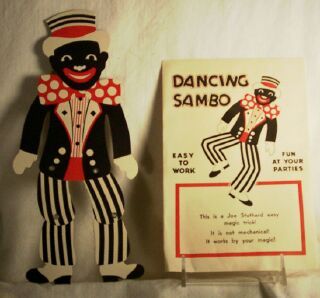
(it's "fun at parties" apparently...)
But beneath the racism, Ellison uses the doll to symbolize some larger themes. Upon more careful examination of the doll, the narrator sees that "it had two faces, one on either side of the disk of cardboard." This reminded me of Bledsoe and how he molds himself into an amiable subservient man before talking to Mr. Norton, after showing his true colors to the narrator (The only fault with this comparison is that both sides of Sambo's face are grinning. Any thoughts on what this suggests?). I also feel like this two-facedness is also representative of the grandfather, especially since Sambo's hands are said to be "doubled into fists," indicating some pent-up anger and rebellion that isn't shown on the face.
However, I found it most interesting when the narrator discovered that the doll could only dance when a person controlled it using a string. I feel like this puppet is a symbol of the narrator in this point in time because he is being made to dance for the crowds by the Brotherhood, who act as the hand controlling the "invisible thread." It seems as though the Brotherhood bought the narrator just like one buys a Sambo for "the brotherly two bits of a dollar." The narrator is absolutely repulsed by the dolls, and yet he still seems blind to their message.
However, I found it most interesting when the narrator discovered that the doll could only dance when a person controlled it using a string. I feel like this puppet is a symbol of the narrator in this point in time because he is being made to dance for the crowds by the Brotherhood, who act as the hand controlling the "invisible thread." It seems as though the Brotherhood bought the narrator just like one buys a Sambo for "the brotherly two bits of a dollar." The narrator is absolutely repulsed by the dolls, and yet he still seems blind to their message.
Sunday, September 14, 2014
Increasingly Visible
Since the first chapter, the narrator of Invisible Man has changed immensely. In class we have said that he is moving more toward the character we see in the prologue. But I also think that the narrator is becoming less invisible as time goes on. Let me explain.
The narrator we see in the first few chapters seems extremely ordinary. He doesn't want to stick out from the crowd and his every action seems to be done in order to serve someone. During the battle royal in Chapter 1, the narrator doesn't try to win and even starts losing when he realizes he might please more of the white men if he does. When giving his speech, he is ignored by the listeners. Later, when the narrator is driving Mr. Norton around, he does exactly what he is told, "following the white line", but once Trueblood begins telling his story, the reader forgets the narrator is even there listening. This is a character that is straining to be heard and liked and yet is very forgettable. He is utterly bland and lacks personality other than being a subservient yes-man.
However, as we progress through the novel, the narrator is slowly evolving into someone more meaningful. Once he reaches New York, he seems to gain an identity. At first, as we see in the diner, he's just the "Southern boy", and he wants to shrug the label off. When he meets the cart-pusher in Chapter 9, the man makes the narrator think about his childhood and by the end, the narrator feels a sense of pride and disgust. The pride here is important because that it's that flash of pride that will grow over time. After the paint factory incident, the narrator rethinks the question of who he really is, and soon after, the reader sees him buying yams and thinking of the times when he would "squeeze the sweet pulp from the soft peel as we hid from the teacher behind the largest book, the World's Geography." Then he realizes: "What and how much had I lost by trying to do only what was expected of me instead of what I myself had wished to do?" For me, this is a moment when I can see the narrator clearly. No longer is he trying to push down his culture and his background.
While its true that how the narrator thinks is becoming more similar to the thoughts he has in the prologue, I wouldn't say he is becoming more like an "invisible man." Instead, he seems to be finding himself. He now has a tangible background and an identity that is so much more vivid than the character of Chapter 1. This, I think, makes him more visible than invisible. But with all that's happened in the book so far, all of that may be subject to change.
The narrator we see in the first few chapters seems extremely ordinary. He doesn't want to stick out from the crowd and his every action seems to be done in order to serve someone. During the battle royal in Chapter 1, the narrator doesn't try to win and even starts losing when he realizes he might please more of the white men if he does. When giving his speech, he is ignored by the listeners. Later, when the narrator is driving Mr. Norton around, he does exactly what he is told, "following the white line", but once Trueblood begins telling his story, the reader forgets the narrator is even there listening. This is a character that is straining to be heard and liked and yet is very forgettable. He is utterly bland and lacks personality other than being a subservient yes-man.
However, as we progress through the novel, the narrator is slowly evolving into someone more meaningful. Once he reaches New York, he seems to gain an identity. At first, as we see in the diner, he's just the "Southern boy", and he wants to shrug the label off. When he meets the cart-pusher in Chapter 9, the man makes the narrator think about his childhood and by the end, the narrator feels a sense of pride and disgust. The pride here is important because that it's that flash of pride that will grow over time. After the paint factory incident, the narrator rethinks the question of who he really is, and soon after, the reader sees him buying yams and thinking of the times when he would "squeeze the sweet pulp from the soft peel as we hid from the teacher behind the largest book, the World's Geography." Then he realizes: "What and how much had I lost by trying to do only what was expected of me instead of what I myself had wished to do?" For me, this is a moment when I can see the narrator clearly. No longer is he trying to push down his culture and his background.
While its true that how the narrator thinks is becoming more similar to the thoughts he has in the prologue, I wouldn't say he is becoming more like an "invisible man." Instead, he seems to be finding himself. He now has a tangible background and an identity that is so much more vivid than the character of Chapter 1. This, I think, makes him more visible than invisible. But with all that's happened in the book so far, all of that may be subject to change.
Monday, September 1, 2014
Present-day
When I was in Chicago this Labor Day weekend, I got to thinking about Native Son. Richard Wright provided the addresses of Bigger Thomas as well as the Dalton family in his book, so I decided to post a few pictures of what these sites look like today...
3721 (South) Indiana Avenue, Chicago, IL: Home of Bigger Thomas


3721 (South) Indiana Avenue, Chicago, IL: Home of Bigger Thomas
4605 (South) Drexel Boulevard, Chicago, IL: The Dalton Household
Photos from Google Maps (couldn't get my parents to drive me to the actual addresses!)
Im assuming that the actual houses/apartments that Richard Wright wrote of were fictional but seeing the locations makes the whole book seem more real. Hope you found this interesting!
Sunday, August 31, 2014
A Small Biography

While reading the first few chapters of Invisible Man, by Ralph Ellison, I became curious about the author himself. Honestly, the only time I had heard about his book was in another book that I had read last year, The Book Thief. So I did a bit of digging and here's what I found.
Ralph Waldo Ellison was born in Oklahoma City on March 1, 1914. In case any of you were wondering, yes, he was named after Ralph Waldo Emerson, a choice made by his father who wanted his son to become a poet. Interestingly, because Oklahoma was a state with little history of slavery (being a 'frontier' state) Ellison grew up with more freedom than some African Americans had, even those in the North. He was able to go to a good school, get tutors and mentors that were white as well as black, and had access to the town's public library. His family was poor but this better racial status could be why Invisible Man is so different than the harsh protest novels of its day (including Richard Wright's Native Son). At least so far in the novel, Ellison's attacks against racism are much more subtle (and possibly more light-hearted?) than in Native Son. His character is also quite the opposite, being educated and self-aware.
Another interesting thing I found was that after studying music in Alabama, Ellison moved to New York to study photography and while there, met Richard Wright (of all people!) who pointed him towards a career in writing fiction. The two were members of the Communist party until World War II caused Ellison to abandon it, thinking the party had betrayed African Americans. It wasn't until after serving in the Merchant Marines that Ellison began working on Invisible Man, which took him from 1947 to 1951.
Just some things to think about while reading the book!
Monday, August 25, 2014
The Opening Scene for the Opening Post
It's hard to start something. It's true of a blog, but Richard Wright too had trouble in beginning his novel, Native Son.
"When I sat down to the typewriter... I could not think of a good opening scene for the book. I had definitely in mind the kind of emotion I wanted to evoke in the reader in that first scene, but I could not think of the type of concrete event that would convey the motif of the entire scheme of the book"
The scene that Wright eventually settled on was one in which the reader wakes up with Bigger in the Thomas family's tiny apartment. The family has been terrorized by a large rat for quite some time and it is this morning when Bigger confronts the rat and kills it. This scene, according to Wright, "conveys the motif of the entire scheme of the book", but how?
To answer that, I'll first take a look at the character of the rat, a representation of Bigger Thomas himself. Physically, it's like Bigger in that it's big and black. Okay. But more interesting parallels can be drawn in looking at the emotions behind the boy and the animal. As a more simple creature, the rat has fairly basic, yet strong, instincts and feelings. The one most obviously present here is fear: fear of the other animals in his world and fear of being killed. The rat, like Bigger, tries to prevent its fear by lashing out in violence. It will try to defend itself from the objects threatening its life. Later, realizing it can't win against the larger forces, the rat tries to hide and get back into its hole before it is killed. In the character of the rat, Wright paints us the general picture of Bigger Thomas: a scared man, who will lash out in fear, only to die in the end.
Another interesting point that I could talk a lot about, but instead will just mention: The idea that Bigger is only a product of society and that his life is almost predetermined (key ideas of naturalism) also makes Bigger a "rat" in a maze.
As we can draw many connections between the rat and Bigger, I think we can do the same between the Thomas family's reaction to the rat and white society's reaction to Bigger. In this first scene of Native Son, the family first hears the rat scuttling about and is immediately frightened. This reminds me of early scenes of Book I of the novel, where Bigger is only milling around, but where the tension between himself and white society is definitely present. They are afraid of him (not him specifically, but of African Americans) and he is afraid of them. Then, the rat makes the first move, jumping out in an attack to break the painful suspense, a parallel to Bigger's killing of Mary Dalton. Almost immediately we begin to hear the shouts of Bigger's family.
""Hit 'im, Bigger!" Buddy shouted.
"Kill 'im!" the woman screamed." (p. 5)
Sounds a little like the lynch mob that emerges after Bigger is publicized to be the murderer of Mary. At this point, the Thomas family wants the rat out of their lives. They don't care about the value of its life, only that it 'threatens' theirs. Finally, Bigger throws a skillet and crushes the rat, foreshadowing the crushing of his own life by a power so much larger than himself.
Ending a blog post is pretty difficult too. Completing the last scene was the second-to-last thing Wright did to finish writing his book. But I'll save my analysis of the last scene for later...
"When I sat down to the typewriter... I could not think of a good opening scene for the book. I had definitely in mind the kind of emotion I wanted to evoke in the reader in that first scene, but I could not think of the type of concrete event that would convey the motif of the entire scheme of the book"
The scene that Wright eventually settled on was one in which the reader wakes up with Bigger in the Thomas family's tiny apartment. The family has been terrorized by a large rat for quite some time and it is this morning when Bigger confronts the rat and kills it. This scene, according to Wright, "conveys the motif of the entire scheme of the book", but how?
To answer that, I'll first take a look at the character of the rat, a representation of Bigger Thomas himself. Physically, it's like Bigger in that it's big and black. Okay. But more interesting parallels can be drawn in looking at the emotions behind the boy and the animal. As a more simple creature, the rat has fairly basic, yet strong, instincts and feelings. The one most obviously present here is fear: fear of the other animals in his world and fear of being killed. The rat, like Bigger, tries to prevent its fear by lashing out in violence. It will try to defend itself from the objects threatening its life. Later, realizing it can't win against the larger forces, the rat tries to hide and get back into its hole before it is killed. In the character of the rat, Wright paints us the general picture of Bigger Thomas: a scared man, who will lash out in fear, only to die in the end.
Another interesting point that I could talk a lot about, but instead will just mention: The idea that Bigger is only a product of society and that his life is almost predetermined (key ideas of naturalism) also makes Bigger a "rat" in a maze.
As we can draw many connections between the rat and Bigger, I think we can do the same between the Thomas family's reaction to the rat and white society's reaction to Bigger. In this first scene of Native Son, the family first hears the rat scuttling about and is immediately frightened. This reminds me of early scenes of Book I of the novel, where Bigger is only milling around, but where the tension between himself and white society is definitely present. They are afraid of him (not him specifically, but of African Americans) and he is afraid of them. Then, the rat makes the first move, jumping out in an attack to break the painful suspense, a parallel to Bigger's killing of Mary Dalton. Almost immediately we begin to hear the shouts of Bigger's family.
""Hit 'im, Bigger!" Buddy shouted.
"Kill 'im!" the woman screamed." (p. 5)
Sounds a little like the lynch mob that emerges after Bigger is publicized to be the murderer of Mary. At this point, the Thomas family wants the rat out of their lives. They don't care about the value of its life, only that it 'threatens' theirs. Finally, Bigger throws a skillet and crushes the rat, foreshadowing the crushing of his own life by a power so much larger than himself.
Ending a blog post is pretty difficult too. Completing the last scene was the second-to-last thing Wright did to finish writing his book. But I'll save my analysis of the last scene for later...
Subscribe to:
Posts (Atom)