Shake him, shake him, you cannot break him
For he's Sambo, the dancing, Sambo, the prancing,
Sambo, the entrancing, Sambo Boogie Woogie paper doll.
And all for twenty-five cents, the quarter part of a dollar…
Ladies and gentlemen, he'll bring you joy, step up and meet him,
Sambo the--
... representation of the narrator and of the struggles African Americans were facing at the time of Ralph Ellison's Invisible Man.
In Chapter Twenty, the narrator finds Tod Clifton, a disappeared member of the Brotherhood, peddling the "obscene" Sambo dolls just before his violent death. The dolls, for one thing, are like the Jolly Coin Bank in that they are obviously symbols of racism and the stereotyped perceptions of African Americans. It is grinning and dancing for a crowd that takes pleasure in watching it perform, which we can see by their "chuckles" as it dances, and by the "indignant" looks the narrator is given (and an old lady's cry) when he interrupts the dance. Here's an image of what Ellison is writing about:
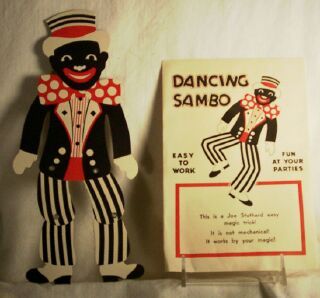
(it's "fun at parties" apparently...)
But beneath the racism, Ellison uses the doll to symbolize some larger themes. Upon more careful examination of the doll, the narrator sees that "it had two faces, one on either side of the disk of cardboard." This reminded me of Bledsoe and how he molds himself into an amiable subservient man before talking to Mr. Norton, after showing his true colors to the narrator (The only fault with this comparison is that both sides of Sambo's face are grinning. Any thoughts on what this suggests?). I also feel like this two-facedness is also representative of the grandfather, especially since Sambo's hands are said to be "doubled into fists," indicating some pent-up anger and rebellion that isn't shown on the face.
However, I found it most interesting when the narrator discovered that the doll could only dance when a person controlled it using a string. I feel like this puppet is a symbol of the narrator in this point in time because he is being made to dance for the crowds by the Brotherhood, who act as the hand controlling the "invisible thread." It seems as though the Brotherhood bought the narrator just like one buys a Sambo for "the brotherly two bits of a dollar." The narrator is absolutely repulsed by the dolls, and yet he still seems blind to their message.
However, I found it most interesting when the narrator discovered that the doll could only dance when a person controlled it using a string. I feel like this puppet is a symbol of the narrator in this point in time because he is being made to dance for the crowds by the Brotherhood, who act as the hand controlling the "invisible thread." It seems as though the Brotherhood bought the narrator just like one buys a Sambo for "the brotherly two bits of a dollar." The narrator is absolutely repulsed by the dolls, and yet he still seems blind to their message.


